FIRE Explained: The One Number That Decides When You Can Retire
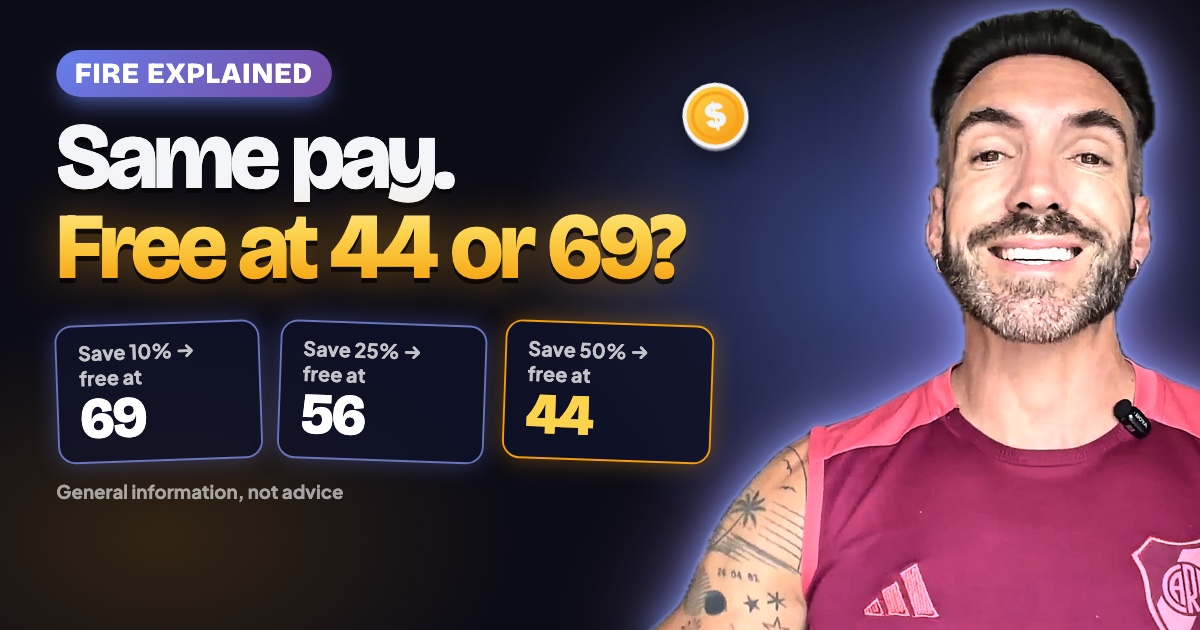
Two friends earn the same pay. One can stop working at 44, the other is still going at 69. The difference isn't the job or a lucky stock pick. It's one number.
Two friends earn exactly the same money. Same job, same pay, same city. One of them can stop working at forty four. The other one is still going at sixty nine.
The difference isn't a better job. It isn't a lucky stock pick. It's one number. By the end of this post, you'll know how to work out your FIRE number, and the number that decides how fast you get there.
Quick note: this is general information, not personal financial advice. Everyone's situation is different, so think about yours, or talk to a licensed adviser.
What FIRE actually is
FIRE stands for financial independence, retire early. The idea goes back to the 1990s (the book Your Money or Your Life is usually credited as the root of it), and it really took off online in the 2010s.
The two halves are very different things:
- Financial independence means your investments can pay for your life. Work becomes optional. You might still work. You might love your job. But you don't have to do it for the money.
- Retire early is the optional bit. Plenty of people who reach financial independence keep working, just on their own terms: fewer hours, a different job, a business, a long break.
So think of FIRE as one thing: buying back your time.
How to work out your FIRE number
So how much do you need? The usual answer is surprisingly simple. Take what you spend in a year, and multiply it by twenty five.
- Spend $40,000 a year → your FIRE number is $1,000,000.
- Spend $20,000 a year → it's $500,000.
(Illustrative numbers.)
Where does 25 come from? The 4% rule
Back in the 1990s, researchers in the US looked at stock and bond returns going back decades. They asked a simple question: if you take out 4% of your money in the first year, and then the same amount plus inflation every year after, how long does it last?
In almost every period they tested, it lasted at least thirty years (William Bengen, 1994, and the "Trinity study", 1998).
Four per cent is one twenty-fifth. So twenty five times your spending lets you take out 4% a year.
Three catches
I'm not here to sell you a fairy tale, so here are the catches:
- That research was about thirty years. If you stop at forty, your money may need to last fifty. A lot of early retirees plan on 3 to 3.5% instead, which means a bigger number (roughly 29 to 33 times your spending).
- It's based on past returns, mostly in the US. The future can be different.
- It ignores the things that depend on where you live, like pensions, healthcare and tax. Those can push your number up or down.
If your plan is to live off rising prices and withdrawals, it helps to know what return to plan on before you plug numbers into any calculator.
The number that matters most: your savings rate
Here's the part most people miss.
Your savings rate is the share of your take-home pay that you save and invest. If you take home $5,000 a month and invest $500, your savings rate is 10%.
And saving more works twice:
- More money goes in every month, so your pot grows faster.
- You're living on less, so the number you need is smaller.
You run faster, and the finish line moves closer. At the same time.
Same pay at 10%, 25% and 50%
Here's what that does on the free FIRE calculator on PimpMyWealth. Someone who's thirty, with $10,000 already invested, taking home $5,000 a month. A 6% return, a 4% withdrawal rate, a 10% cushion on spending, and savings rising 3% a year (illustrative):
| Saved a month | FIRE number | Time | Free at |
|---|---|---|---|
| $500 (10%) | $1,485,000 | 39 years | 69 |
| $1,250 (25%) | $1,237,500 | 26 years | 56 |
| $2,500 (50%) | $825,000 | 14 years | 44 |
Same pay. Same return. Same calculator. Twenty five years of difference, just from the savings rate.
Why savings rate beats chasing returns
In the same calculator, at a 25% savings rate, getting 7% a year instead of 6% only brings it forward by about two and a half years. Going from a quarter to a half brings it forward by twelve.
You don't control the return. Nobody does. But you do control your savings rate.
How to lift your savings rate
No need to live on rice and beans. Three ideas:
- Go after the big three. For most people the biggest costs are housing, transport and food. Cutting a coffee here and there barely moves the needle. A cheaper rent, a cheaper car, or cooking at home most nights can move your savings rate by five or ten per cent on its own.
- Save your pay rises. When your income goes up, it's easy for spending to go up with it: lifestyle creep. Try sending half of every raise straight to your investments. You still feel richer, but your savings rate climbs every year.
- Automate it. Set up a transfer to your investments on payday, before you see the money. You can't spend what never lands in your spending account.
The honest downsides
Before you quit your job tomorrow:
- Timing. If the market drops hard in your first year or two of living off your investments, that hurts a lot more than a drop twenty years later. That's why many people keep a year or two of spending in cash, or a bit of part-time income at the start.
- Life. Health, kids, family, moving country. Plans change, and that's fine. A FIRE plan is a direction, not a contract.
- Being too extreme. If you make yourself miserable for fifteen years to escape a job, you've swapped one kind of unhappy for another. The goal is more freedom, not less life.
That's also why you'll hear about different kinds of FIRE: Lean FIRE (a small budget), Fat FIRE (a much bigger one), Coast FIRE (you've saved enough early to stop investing and let it grow) and Barista FIRE (a bit of part-time work covers some of your costs).
Your first step
It takes five minutes. Work out your savings rate:
What you saved and invested last month ÷ what you took home × 100
Whatever it is, don't judge it. Just try to nudge it up by one or two per cent this year.
Quick recap
- FIRE is about making work optional, not about hating your job.
- Your FIRE number is roughly 25 times what you spend in a year, from the 4% rule, and many early retirees use a bigger number to be safe.
- Your savings rate matters more than your salary or your returns, because it works twice.
- Push it up with the big three, saving your raises, and automating it.
What's your savings rate right now, and what would you do with your time if work was optional? If you want to find your own FIRE number, the calculators are free on PimpMyWealth.
General information only, not personal financial advice.
Ready to Apply What You've Learned?
Use our powerful calculators to model your financial scenarios and make informed decisions
Try Our Calculators