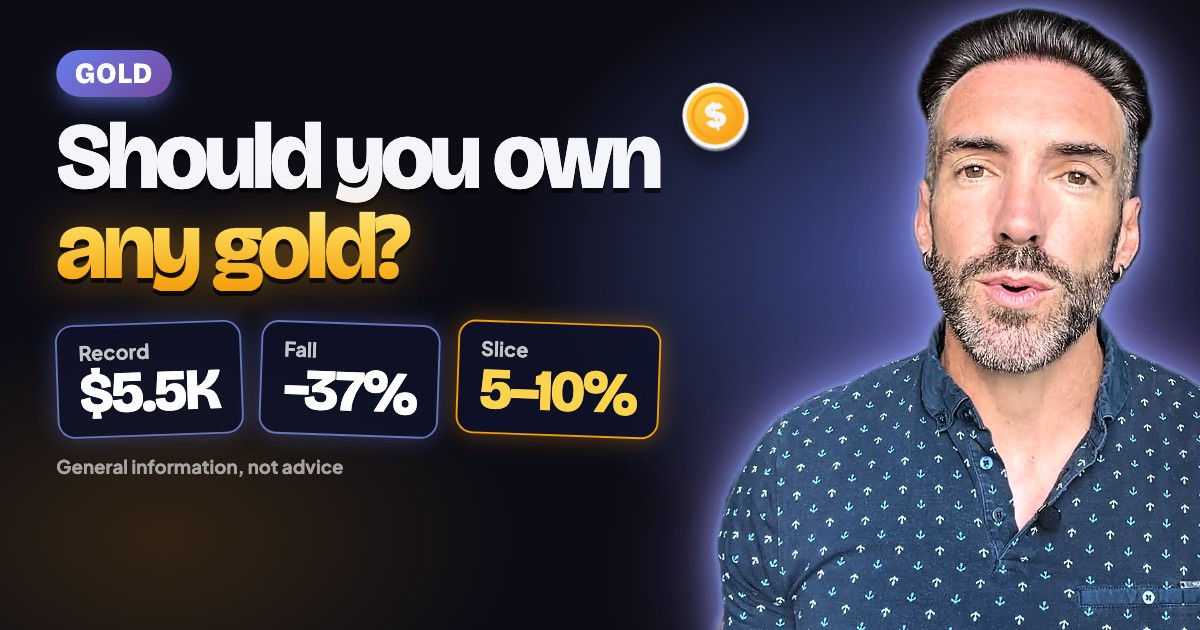
Should You Own Gold? What Gold Can and Can't Do for Your Money
Gold hit a record, then fell more than a third. Should you own gold at all? What it's good for, the trap most people fall into, and how much investors usually hold.
Gold just had its best year in almost half a century. Then it lost more than a third of its value.
If you bought near the top, that hurts. If you didn't buy at all, you're probably wondering if now is your chance. So should you own gold, and if you should, how much? By the end of this post you'll know exactly what gold can do for you, and what it can't.
Quick note: this is general information, not personal financial advice. Everyone's situation is different, so think about yours, or talk to a licensed adviser.
The ride: from a record to a fall of more than a third
In 2025 the price of gold went up by about two thirds, its best year since 1979. In some cities, people queued outside shops to buy gold coins.
Then in January 2026 it went past $5,000 an ounce for the first time, and peaked at around $5,500. Everyone had an opinion about where it was going next.
And then it turned. By late November 2026, gold had dropped below $3,500 an ounce: more than a third below its record, in less than a year.
Why gold went up
- Central banks. These are the banks that run a country's money, like the Federal Reserve in the US. From 2022 to 2024 they bought more than 1,000 tonnes of gold every year, and in 2025 another 863 tonnes. Many want to rely a little less on the US dollar, and gold is something no other country can freeze or print.
- Fear. Wars, trade wars and tariffs made a lot of investors nervous, and nervous investors often buy gold.
- Interest rates were expected to fall. And that matters more than most people think.
Why gold fell: interest rates
Gold doesn't pay you anything. No interest, no dividends, no rent.
When a savings account or a government bond pays you very little, that doesn't matter much. But when inflation picks up again and interest rates look like they're going up, cash and bonds start paying you real money. Suddenly, holding a lump of metal that pays nothing looks expensive. That's what has been happening through 2026.
We go deeper on this in what rising interest rates mean for your money.
What gold actually is, as an investment
When you buy a share, you own a small piece of a business. That business makes things, sells things, and hopefully makes a profit, and some of that profit comes back to you.
When you buy gold, you own a piece of metal. It doesn't make anything. It just sits there. Its price only goes up if someone later wants to pay more for it than you did.
Warren Buffett made this point in his 2011 letter to Berkshire Hathaway shareholders: melt all the gold in the world into one cube and it would be about 20 metres (68 feet) on each side. You could polish it, you could climb on it, but it would never produce anything. That's why most long-term investors don't make gold the main part of their money.
Gold's long history of long waits
In January 1980, gold hit $850 an ounce. By 1999 it had fallen to around $250. And after inflation, it didn't get back to that 1980 peak until 2025: about 45 years of waiting.
Imagine buying gold the year you started work, and only breaking even when you retired.
What gold is good for: a seatbelt, not an engine
So is gold useless? No. It has one job it does quite well: it often holds up when other things fall.
- In 2008, when the share market crashed by more than a third, gold finished the year slightly up.
- In 2022, when shares and bonds both fell at the same time, gold was roughly flat.
That's what diversification means: you own a few different things that don't all fall together.
So gold isn't really an engine for growth. It's more like a seatbelt. You hope you don't need it, but you're glad it's there. For how to split the rest of your money, see stocks vs bonds: how much risk should you take?
The trap: buying the headlines
Here's the trap that catches most people: buying gold because it's in the news.
When something has gone up a lot, it's on every headline, and that's exactly when most people buy. Then it falls, they get scared, and they sell at a loss. They bought high and sold low. The same thing happens with shares, bitcoin, and anything else that gets exciting.
The price you pay matters. And the best time to add a seatbelt is before the crash, not after it.
Three ways to own gold
- Physical gold: bars and coins. You can hold them in your hand, which feels good. But you usually pay more than the gold price when you buy, and get less than it when you sell. And you need somewhere safe to keep it.
- A gold fund (ETF) on a stock exchange. It tracks the price of gold and you buy it like a share. It's simple and cheap to trade, but check the yearly fee.
- Shares in gold mining companies. These are businesses, not gold. They often swing much more than the gold price, up and down, so that's a lot more risk than most people expect.
How much gold should you own?
There's no perfect number. But investors who do hold gold usually keep it to a small slice, often somewhere around 5 to 10 per cent. Not half your money. Not your whole emergency fund. A small slice next to the things that actually grow, like a simple index fund.
And then you rebalance. Once a year, if gold has grown bigger than your slice, you trim it back. If it has shrunk, you top it up. That way you sell a bit when it's expensive and buy a bit when it's cheap, without guessing.
Your 5-minute check
- Look at everything you own and work out what per cent is in gold. If it's zero, that's fine: plenty of investors never own any.
- If it's more than about 10 per cent, ask yourself why.
- If you're thinking of buying now, write down your slice first, and stick to it.
Quick recap
- Gold had a huge run to a record, then fell more than a third.
- It went up on central bank buying, fear, and hopes of lower rates.
- It fell as interest rates started looking higher for longer.
- Gold doesn't produce anything, so it isn't a growth engine.
- It can be a seatbelt that holds up when other things fall.
- If you own it, keep it a small slice, and rebalance once a year.
Want to see what your money could grow into? Try the free calculators at pimpmywealth.com.
Frequently asked questions
Should I buy gold now that the price has fallen?
Nobody knows where the price goes next. A fall doesn't make gold cheap, and a record doesn't make it expensive. Investors who hold gold usually decide their slice first (often around 5–10%) and rebalance once a year, rather than buying because of the news.
Does gold pay any income?
No. Gold pays no interest, dividends or rent. That's why it tends to look less attractive when interest rates on cash and bonds go up.
What's the cheapest way to own gold?
For most people, a gold fund (ETF) on a stock exchange is simpler and cheaper to trade than bars and coins, which usually carry a dealer markup and need safe storage. Check the fund's yearly fee.
Are gold mining shares the same as owning gold?
No. Miners are businesses, and their shares often swing much more than the gold price, up and down. That's more risk than owning gold itself.
Sources
- AP / ABC News, "Gold is set for its best year since Jimmy Carter was president", 31 December 2025.
- CNBC, "Another day another high: Gold surges past $5,100", 26 January 2026.
- CNBC / Reuters, "Gold falls to more than one-year low after data shows U.S. inflation rose further", 25 November 2026.
- World Gold Council, Gold Demand Trends: Full Year 2025 (central banks).
- Bloomberg, 11 September 2025: gold passes its inflation-adjusted January 1980 peak.
- Berkshire Hathaway 2011 shareholder letter (published February 2012).
General information only, not financial advice. Figures are rounded; past performance doesn't tell you what happens next.
Ready to Apply What You've Learned?
Use our powerful calculators to model your financial scenarios and make informed decisions
Try Our Calculators