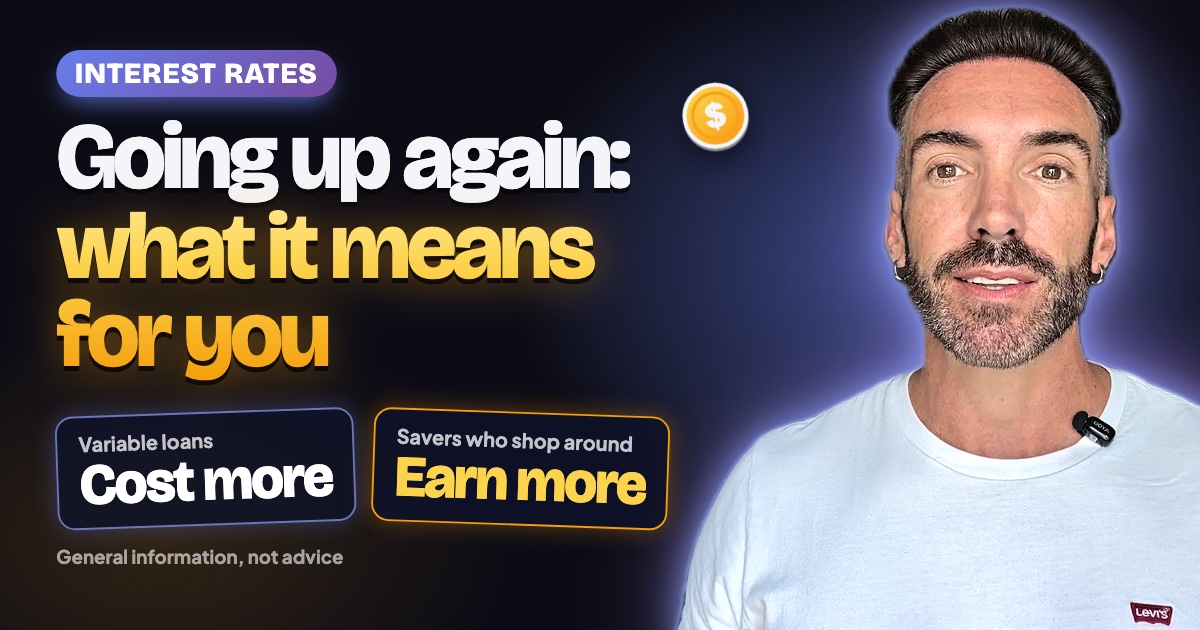
Interest Rates Are Going Up Again: What It Means for Your Money
Interest rates are going up again. What rising rates mean for your mortgage, loans, savings, bonds and shares, plus five moves worth making when rates rise.
In November 2026, the Bank of England raised interest rates for the first time since 2023. The same week, Australia's central bank raised rates for the fifth time this year. And in America, the Federal Reserve raised rates in September, with most experts expecting another rise in December.
For years, everyone was talking about rate cuts. Now, in a lot of countries, interest rates are going up again.
So what does that actually mean for your money? Your mortgage, your loans, your savings and your investments. Below I'll walk you through all four, and the five moves worth making when rates are rising.
I spent years in financial planning and investment management, and every time rates moved, my phone started ringing.
Quick note: this is general information, not advice. Every example number is illustrative unless I say where it comes from, and investing always comes with risk.
What is an interest rate?
An interest rate is simply the price of money. If you borrow money, it's what you pay. If you save money, it's what you get paid.
Every country has a central bank that sets one main rate, and almost every other rate follows it: your mortgage, your car loan, your credit card and your savings account.
So why would a central bank push rates up? To fight inflation. When prices are rising too fast, higher rates make borrowing more expensive and saving more attractive. People and businesses spend a bit less, and over time, that cools prices down.
Think of it like a tap. Lower rates turn the money tap on. Higher rates turn it down. Right now, a lot of central banks are turning the tap down, because inflation has been stubborn.
What rising interest rates mean for your mortgage
This is the one that hurts the most. The first thing to know: is your loan fixed or variable?
- A fixed rate stays the same for a set time, so a rate rise doesn't change your repayment until that time runs out.
- A variable rate moves with the market, so when rates go up, your repayment goes up too, often within weeks.
Imagine my mate Sam. Sam has a $300,000 mortgage over 25 years on a variable rate (illustrative).
- At 5%, his repayment is about $1,754 a month.
- If his rate goes up to 6%, it jumps to about $1,933 a month.
That's around $180 more, every single month. Over the whole loan, one percent more costs him about $54,000 extra in interest. From just one percentage point.
Other loans get more expensive too
It's not only mortgages. Any debt with a variable rate gets more expensive.
Here's what the free debt payoff calculator on PimpMyWealth shows. The example is a $5,000 credit card at 18% and a $20,000 student loan at 5%. Paying only the minimums, it takes 10 years and 10 months to be debt free, with $7,909 in interest.
Now raise the loan's rate to 7%. The same payments now take 12 years and 7 months, and the interest jumps to $12,087. That's more than $4,000 extra, for doing exactly the same thing.
The good news for savers
If you're a saver, rising rates are on your side. Banks pay more on savings accounts and term deposits when the main rate goes up.
The compound interest calculator shows it. Start with $10,000, add $200 a month and leave it for 10 years:
- At 1%, you end up with about $36,302. Only $2,302 of that is interest.
- At 4%, it's about $44,456. That's $10,456 of interest.
Same money in, same ten years, more than four times the growth.
But here's the catch. Banks are usually very quick to raise the rate on your loan, and a lot slower to raise the rate on your savings. If your savings account is still paying almost nothing, that's the bank keeping the difference. Don't let it sit there. Shop around, and move it to an account that actually passes the rise on to you.
One more thing: what really matters is your real rate, your rate after inflation. If your savings earn 4% and prices rise 3%, you're only really ahead by about 1%. Still better than going backwards.
Bonds: prices down, future income up
A bond is basically a loan you give to a government or a company, and they pay you interest. When rates go up, the price of existing bonds usually goes down.
Here's why. Say you own a bond paying 3%. Then new bonds come out paying 5%. Nobody wants to pay full price for your 3% bond anymore, so its price drops.
That's exactly what happened in 2022, when rates jumped and the main US bond index had its worst year on record. I covered this in Stocks vs Bonds: How Much Risk Should You Actually Take?
But there's a silver lining. When bond prices fall, the new interest you can earn goes up. So for long-term investors, higher rates today can mean better income tomorrow.
Shares: two ways rates can hit them
Higher rates can hit shares in a couple of ways:
- Borrowing costs more for companies, so some of them make less profit.
- When you can earn a decent rate on safe cash, investors are less willing to pay sky-high prices for shares.
That's why fast-growing tech companies often get hit the hardest when rates rise.
But here's what history really shows. Sometimes shares fall when rates go up. And sometimes they keep climbing, because the economy is strong enough to handle it. There's no rule that says rate rises mean a crash. Nobody, not me and not the experts on TV, knows for sure where rates or shares will be next year. That's history, not a forecast.
Five moves to make when interest rates rise
- Know what kind of loan you have. Find out if your rate is fixed or variable, and if it's fixed, when that fixed time ends.
- Stress test your budget. Could you still pay your loans if rates went up another 2%? If the answer is no, start building a cash buffer now, not when the letter from the bank arrives.
- Attack your most expensive debt first. Credit cards and other high-interest debts get even nastier when rates rise. My post on paying off debt vs investing explains why.
- Make your cash work. If you've got savings, check your rate today, and move it if it's lazy.
- Don't panic. Don't sell your long-term investments because of one headline about interest rates. Rates go up, and rates come down. The people who do best are the ones who stick to their plan through both.
Recap
- Interest rates are the price of money, and central banks raise them to fight inflation.
- If your loan is variable, rising rates hit your repayments, often fast.
- If you're a saver, rising rates help, as long as you shop around.
- Bond prices usually fall when rates rise, but future income goes up.
- Shares can wobble, but nobody can predict them.
Want to see what a rate rise does to your own numbers? Try the free calculators on PimpMyWealth. And tell me: where do you live, and what is your interest rate doing right now?
Sources
- Bank of England, Bank Rate raised to 4%, Monetary Policy Summary, 5 November 2026.
- Reserve Bank of Australia, cash rate target raised to 4.85%, media release, 3 November 2026.
- US Federal Reserve, target range raised to 3.75%–4%, FOMC statement, 16 September 2026; October FOMC minutes, released 18 November 2026.
- Bloomberg US Aggregate Bond Index, 2022 calendar-year return.
- Calculator figures: pimpmywealth.com debt payoff and compound interest calculators, recorded 23 November 2026. Illustrative.
General information only, not financial advice. It doesn't take your personal situation into account. Past performance is not a reliable guide to the future.
Ready to Apply What You've Learned?
Use our powerful calculators to model your financial scenarios and make informed decisions
Try Our Calculators