Visual Learning Hub
Understand complex financial concepts through beautiful infographics
The magic of compound interest
$10/day
= $300/month invested
Growth Over Time: Three Scenarios
5% Return
Conservative Portfolio
Government bonds, high-grade corporate bonds, conservative index funds
~54 years
to reach $1,000,000
7% Return
Typical Stock Market
Long-term historical average for diversified stock market investments
~43 years
to reach $1,000,000
10% Return
Aggressive Portfolio
High-growth stocks, emerging markets, technology sector focus
~34 years
to reach $1,000,000
Small habits + time = massive long-term wealth.
Consistency beats intensity.
Key Takeaways
Start Today, Not Tomorrow
Every year you wait costs you tens of thousands in future wealth
Automate Your Investments
Set up automatic monthly transfers so you never miss a contribution
Don't Time the Market
Regular investing smooths out market volatility over time
Stay the Course
Market dips are normal - they're buying opportunities, not reasons to panic
PimpMyWealth
Where to start your investing journey - build from the bottom up
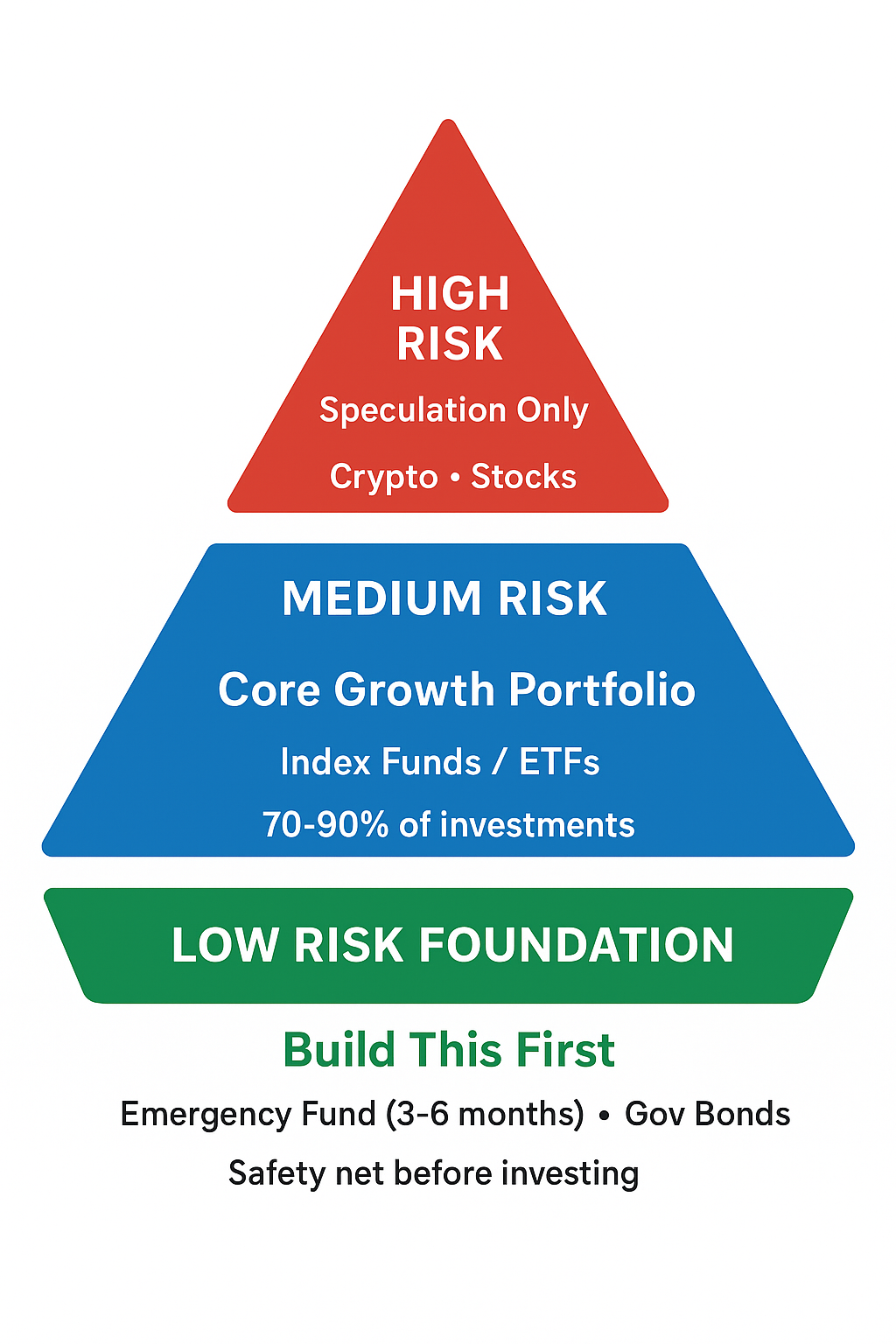
Step 1: Foundation
Start here! Build your emergency fund before investing. This protects you from life's surprises.
Step 2: Core Portfolio
Once you have your safety net, invest in ETFs for long-term growth. This should be 70-90% of your portfolio.
Step 3: Speculation
Only after steps 1 and 2, consider speculative investments with money you can afford to lose (max 10%).
Pro Tip: Most successful investors keep 80-90% of their money in the bottom two layers. The top layer is optional and should only be a small percentage of your total portfolio. Don't skip the foundation to chase high-risk investments!
How a 1% fee difference can cost you hundreds of thousands over time
Final Portfolio Value After 35 Years
Both scenarios invest $500/month with 7% market returns
Low Fees (0.3%)
Hidden Fees (1.3%)
Wealth lost to fees over 35 years:
$210,000
That's more than 3 years of your salary disappearing into fees!
Where Hidden Fees Come From
Management Fees
Fund managers charge annual fees to run the fund (MER or Management Expense Ratio)
Advisory Fees
Advisors charging percentage-based fees (1-2% annually) compound against you. Look for transparent fee-for-service models instead
Trading Costs
Buy/sell spreads, brokerage fees, and transaction costs
How to Minimize Fees
Choose Low-Cost Index ETFs
ETFs like VAS, VGS, or VDHG have fees under 0.3% annually compared to 1-2% for actively managed funds
Avoid "Active" Managed Funds
Research shows 90% of active managers don't beat the market after fees over the long term
Seek Fee-For-Service Financial Advice
Instead of percentage-based fees (1-2% annually), look for advisors who charge transparent flat fees or hourly rates. This fee structure is more aligned with your interests
Use Commission-Free Brokers
Many modern brokers offer $0 brokerage on ETF purchases, eliminating transaction costs
"Fees compound just like returns —
except they compound against you."
Why Most People Buy High and Sell Low
A Timeline of Emotions
It's not intelligence — it's emotions
The Emotional Investing Cycle
What Disciplined Investors Do Instead
Emotional Investors
React to market moves
Buy when prices are high, sell when low
Chase headlines
Follow hot tips and FOMO trends
Make impulsive decisions
Let fear and greed drive choices
Time the market
Try to predict peaks and valleys
Disciplined Investors
Follow a plan
Stick to their strategy regardless of emotion
Stay consistent
Invest regularly with dollar-cost averaging
Think long-term
Focus on years and decades, not days
Buy when others panic
See market drops as opportunities
How to Avoid Emotional Investing
Automate Everything
Set up automatic monthly investments. You can't make emotional decisions if the choice is already made.
Stop Watching the News
Financial media thrives on fear and hype. Check your portfolio quarterly, not daily.
Write Down Your Plan
Document your investment strategy. When emotions run high, reread it. Your calm self knows better.
The Reality
When the market is soaring:
You'll feel like a genius. Your friends will brag about gains. CNBC will say "this time is different." You'll want to buy more. This is when you should be cautious.
When the market is crashing:
You'll feel sick to your stomach. Headlines will scream doom. Your portfolio will be red. You'll want to sell everything. This is when you should be buying.
The best investors do the opposite of what feels natural. That's why it's so hard — and so profitable.
"The hardest part of investing isn't the market —
it's managing your emotions."
Stay the course. Trust the process. Ignore the noise.
PimpMyWealth
How your money grows exponentially over time
Starting Early vs. Starting Late
Sarah, Age 25
Invests $500/month for 10 years, then stops
John, Age 35
Invests $500/month for 30 years
Key Takeaway
Sarah invested 1/3 as much but ended up with MORE!
How It Works
Earn 8% = $800
New balance: $10,800
Earn 8% = $864 (more than year 1!)
New balance: $11,664
Each year you earn interest on your interest
Growth accelerates over time!
Einstein called it: "The 8th wonder of the world. Those who understand it, earn it; those who don't, pay it."
How to balance stocks and bonds as you age
20s - 30s
Young investors can take more risk with high stock allocation for maximum growth
40s - 50s
Mid-career investors balance growth with some stability as retirement approaches
60s+
Retirees prioritize stability and income with higher bond allocation
Rule of Thumb: A common guideline is to subtract your age from 110 or 120 to determine your stock allocation. For example, a 30-year-old might hold 80-90% stocks (110-30=80 or 120-30=90). This is just a starting point—adjust based on your risk tolerance and goals.
Your financial journey from 25 to retirement
Foundation Years
Start investing early, even small amounts. Focus on high-growth ETFs. Build emergency fund.
Growth Phase
Increase contributions as income grows. Max out retirement accounts. Maintain aggressive portfolio.
Acceleration
Peak earning years. Significantly boost savings. Start considering diversification into bonds.
Pre-Retirement
Shift towards stability. Reduce risk gradually. Consider healthcare and estate planning.
Retirement
Live off dividends and strategic withdrawals. Preserve capital. Enjoy the fruits of your labor!
Why investing regularly beats timing the market
Scenario: Investing $1,000/month
Buy 20 shares
Buy 25 shares (more shares when cheaper!)
Buy 16.67 shares (fewer when expensive)
Average cost per share: $48.78
Better than the simple average of $50!
Why It Works
Removes Emotion
You invest consistently regardless of market conditions
Buy More When Low
Market dips become opportunities, not disasters
No Perfect Timing Needed
Nobody can predict the market—DCA makes it irrelevant
Builds Discipline
Creates a sustainable investing habit
Understanding the relationship between risk and potential gains
Cash/Savings
Risk: Very Low
Volatility: None
Bonds
Risk: Low
Volatility: Low
ETFs/Index
Risk: Medium
Volatility: Medium
Individual Stocks
Risk: High
Volatility: High
Key Insight: Higher potential returns come with higher risk. Most millennial investors benefit from ETF-based portfolios that balance risk and return. The goal isn't to eliminate risk—it's to take smart, calculated risks appropriate for your age and goals.
Don't put all your eggs in one basket
Not Diversified
All money in one tech stock
- • Company goes bankrupt → Lost everything
- • Tech sector crashes → Portfolio devastated
- • No protection from market swings
100%
One Stock
Well Diversified
Money spread across sectors & regions
- • One company fails → Minor impact
- • One sector down → Others balance it out
- • Protected from regional crashes
Pro Tip: ETFs give you instant diversification. A single broad-market ETF like VGS holds thousands of companies across dozens of countries and sectors—providing protection from any single investment going wrong.
Risk isn't volatility — it's the loss of purchasing power
Two Paths: Starting with $100
Cash Journey
Year 0-5: Comfortable
"My money is safe in the bank"
Year 5-15: Noticing
"Things seem more expensive..."
Year 15-25: Concerned
"I can buy 40% less with the same money"
Investing Journey
Year 0-5: Nervous
"It goes up and down. Is this normal?"
Year 5-10: Anxious
"Market crashed 20%. Should I sell?"
Year 10-20: Confident
"The dips recover. I'm staying the course"
Year 20-25: Grateful
"I can buy 5× more than I started with"
One feels risky.
The other actually is.
The emotional choice isn't always the rational one
Cash – "Low Volatility"
Inflation ~3% per year
$100 → ~$55-60
in real value after 20-25 years
"Feels safe, but quietly loses value."
Visual erosion of purchasing power
Investing – "High Volatility"
Average long-term return ~7% p.a.
$100 → ~$500+
after 25 years
"Feels uncomfortable, but grows purchasing power."
Key Insight:
Volatility is normal. Short-term dips are the price you pay for long-term growth.
Redefining Risk
Risk ≠ Volatility
Short-term price swings aren't the same as permanent loss of wealth
Risk = Inflation Erosion
Losing purchasing power year after year is the real danger
Risk = Doing Nothing
Standing still guarantees you'll fall behind inflation
Real-World Impact
Coffee Example
25 years ago (2000):
$3.00 for a coffee
Today (2025):
$6.00+ for the same coffee
If you held $3,000 in cash: You could buy 1,000 coffees in 2000. Today, that same $3,000 buys only ~500 coffees. You "lost" 500 coffees to inflation.
If you invested $3,000 at 7% return: You'd have ~$15,000 today. That's 2,500 coffees — 5× your original purchasing power!
"The biggest risk isn't market volatility —
it's standing still."
Time in the market beats timing the market
PimpMyWealth
Financial media is designed to maximise clicks, not long-term investment outcomes
The Same Market. Different Headlines.
How media spins identical market conditions
When Markets Rise
Breaking News
THIS MARKET CAN'T LOSE
"Record highs every week as rally shows no signs of slowing"
Experts unanimous: this is just the beginning. Historic bull run continues as investors pour billions into stocks. "We've never seen anything like this," says chief strategist. Get in now or miss out forever.
Emotion: Euphoria
Encourages FOMO buying
Market Watch
Why This Rally Is Just Getting Started
"Analysts predict another 30% gains ahead"
Top Wall Street firms raise targets again. "This time really is different," says veteran analyst. New economic paradigm means old rules don't apply. Don't miss the opportunity of a lifetime.
Investor Alert
Everyone's Getting Rich But You
"Your neighbor just made 40% — what are you waiting for?"
Social media explodes with success stories. Friends sharing screenshots of massive gains. "I quit my job to trade full time," says millennial investor. Are you being left behind?
When Markets Fall
Breaking News
MARKETS IN FREEFALL
"Worst drop in years as panic selling accelerates"
Investors flee to safety as stocks plummet. "This could be the start of something much worse," warns economist. Retirement accounts devastated. Is your money safe? Experts say sell now, ask questions later.
Emotion: Fear
Triggers panic selling
Market Watch
Is This the Next Crash?
"Analysts sound alarm as markets tumble"
Comparisons to 2008 crisis mount. Technical indicators flash warning signals. "Get out while you still can," urges market veteran. No bottom in sight as selling pressure intensifies. Your wealth is at risk.
Investor Alert
Investors Brace for More Pain
"Retirement dreams vanish as portfolios collapse"
Financial advisors overwhelmed with panicked calls. "I've lost everything," sob investors. Safe havens fill up as fear spreads. How much more can you afford to lose? Act before it's too late.
The Reality:
Both columns describe the exact same long-term upward trending market — just at different points in its normal volatility cycle.
What Headlines Trigger
What the Market Actually Does
"The news profits from your emotions.
Your portfolio pays the price."
The Headline Trap
Breaking this cycle is the key to long-term investing success
How Smarter Investors Read the News
Headlines sell emotion, not accuracy
Financial media needs clicks and views. Drama pays. Boring truth doesn't.
Volatility is normal — not a signal
Markets go up and down. That's what they do. It's not a reason to act.
Long-term trends matter more than daily news
What happens this week is noise. What happens over decades is signal.
If it makes you panic, pause
Never make investment decisions while emotional. Wait 24-48 hours.
"If a headline makes you emotional,
it's probably useless for investing."
Good investing is boring. Headlines are not.
PimpMyWealth