Is Renting Really Dead Money? The 5% Rule for Rent vs Buy
Is rent really dead money? Owning has dead money too. The 5% rule turns rent vs buy into one quick sum you can do for any home, anywhere.
Every month you pay rent, someone tells you the same thing. You're throwing money away. You're paying off someone else's mortgage.
But here's the thing nobody mentions: owning a home has its own dead money too. And there's a simple rule, the 5% rule for rent vs buy, that tells you which one costs more, for any home, anywhere in the world. By the end of this post, you'll be able to do it in your head.
Quick note: this is general information, not personal financial advice. Everyone's situation is different, so think about yours, or talk to a licensed adviser.
Why everyone is asking "rent or buy?"
If it feels harder than ever to buy a home, you're not imagining it. In the US, the typical home now costs about five times the typical household's yearly income, about the highest it has ever been. In Australia it's closer to nine times. And across many rich countries, people say affordable housing is harder to find than it has been in years.
So in late 2026, millions of people are asking the same question: should I keep renting, or should I stretch to buy? And the answer most people get is a feeling, not a number. Let's get a number.
Is rent really dead money?
First, the myth. Rent is dead money because you never get it back. That part is true.
But when you own a home, a lot of what you pay you never get back either:
- Mortgage interest goes to the bank, not into your home.
- Property taxes or council rates go to the government.
- Insurance and repairs (a new roof, a new hot water system) all go to someone else.
And there's one more cost people forget completely. The money you put in as a deposit could have been invested somewhere else. If it's locked up in bricks, it isn't growing in the share market. That's called the cost of capital: what your money could have earned somewhere else.
So the real question isn't rent versus nothing. It's the money you never get back when you rent, versus the money you never get back when you own.
The 5% rule for rent vs buy
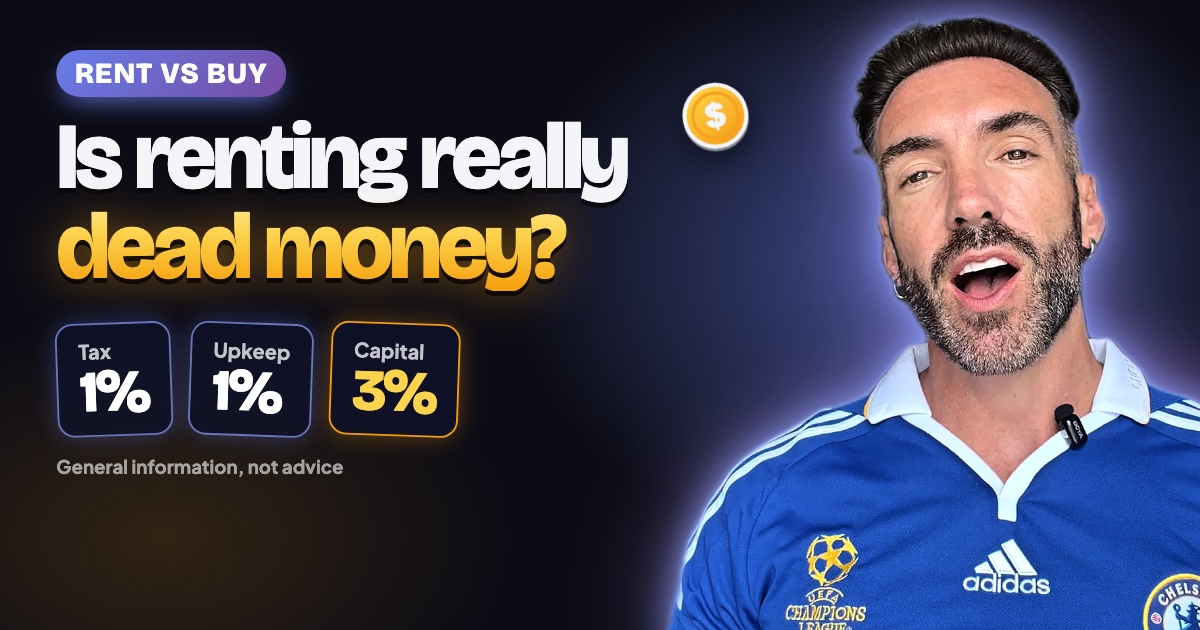
This is where the 5% rule comes in. It's a rule of thumb made popular by Ben Felix, a Canadian portfolio manager at PWL Capital, back in 2019. It says the money you never get back when you own is roughly 5% of the home's value every year:
- about 1% for property tax
- about 1% for maintenance
- about 3% for the cost of capital: the interest on your loan and what your deposit could have earned
How to use it
Take the price of the home, times it by 5%, and divide by twelve. That's the break-even rent.
For a $500,000 home, 5% is $25,000 a year. Divide by twelve, and you get about $2,080 a month (illustrative).
- If you can rent a similar place for less than that, renting is probably cheaper.
- If rent for a similar place costs more than that, buying is probably cheaper.
One multiplication, one division, and you've got a much better answer than "rent is dead money".
Testing it: the same home, three rents
A rule of thumb is nice, but let's test it. Here's an example using the same maths as the rent vs buy calculator on PimpMyWealth (illustrative figures, not a forecast):
- Home: $500,000, 20% deposit, $15,000 buying costs, 30-year mortgage at 6%
- Owning costs another 2% a year, the home grows 5% a year, investments earn 7%
- Rent goes up 3% a year, and the renter invests the deposit instead
- We compare both after 25 years
| Monthly rent | After 25 years |
|---|---|
| $2,000 (about break-even) | Buying ahead by about $53,000: close to a tie |
| $1,500 | Renting and investing ahead by about $447,000 |
| $2,500 | Buying ahead by about $553,000 |
Same house, same mortgage, same growth. Just a $500 change in rent swings the answer by hundreds of thousands of dollars. That's why the price of a home compared with the rent matters more than anything else.
The catch: you have to invest the difference
Here's the big one. Renting only wins if you actually invest the money you didn't spend on a house.
Go back to the $1,500 rent, where renting was way ahead. This time, the renter doesn't invest the deposit. It goes on a nicer car, holidays and everyday life. Now buying comes out ahead, by about $177,000. Same rent, same home. The only thing that changed is what the renter did with the money.
A mortgage is a bit like a forced savings plan: every payment pays off a little more of the house, whether you feel like it or not. Renting gives you the choice, and choices are easy to waste.
So if you rent, make it automatic. Set up a transfer to your investments on payday, before you can spend it. If you're not sure where that money should go, our guide to index funds covers the simple way most people invest it.
Four things the 5% rule leaves out
The 5% rule is a shortcut, not a crystal ball.
- How long you'll stay. Buying and selling a home costs a lot: taxes, fees, agents and moving. If you might move in the next few years, those costs can wipe out any gain, and renting usually wins.
- Interest rates. The 3% for the cost of capital assumes fairly normal interest rates and returns. When mortgage rates are higher, owning costs more, so the break-even rent goes up. More on that in what rising interest rates mean for your money.
- Where you live. Property taxes, repairs and tax breaks for homeowners are very different from country to country, and even city to city. Treat 5% as a starting point, and adjust it.
- The things that aren't money. Owning means stability, a garden, a dog, painting the walls whatever colour you want. Renting means flexibility, moving for a job, and not paying for the new roof. Those are real, and only you can put a price on them.
Your 2-minute test
- Look up the price of a home you'd actually buy.
- Times it by 5% and divide by twelve.
- Compare that with the rent for a similar place in the same area.
If the rent is clearly lower, renting and investing the difference can make a lot of sense. If the rent is clearly higher, buying starts to look good. And if it's close, the numbers are roughly a tie, so decide on lifestyle.
Quick recap
- Rent isn't the only dead money. Owning has its own: about 5% of the home's value a year, from tax, maintenance and the cost of capital.
- Price × 5% ÷ 12 = the break-even rent.
- Renting only wins if you really invest the difference, so automate it.
- Adjust for how long you'll stay, interest rates, where you live, and the life you want.
Where you live, is rent above or below that 5% number? Try the numbers yourself with the free calculators on PimpMyWealth, and do the maths before you sign anything.
Sources
- Ben Felix (PWL Capital), "Renting vs. Buying a Home: The 5% Rule", May 2019
- Harvard Joint Center for Housing Studies, "Home prices surge to five times median income, nearing historic highs", 2025 (2024 data)
- Cotality housing affordability report, 2025 (Australian median dwelling price ≈ 8.9× household income)
- Gallup, "Housing affordability crisis hits wealthy economies", 2025
- PimpMyWealth rent vs buy calculator maths, run 25 November 2026 (illustrative example above)
Ready to Apply What You've Learned?
Use our powerful calculators to model your financial scenarios and make informed decisions
Try Our Calculators