Index Funds Explained: Why Most Fund Managers Can't Beat Them
Index funds explained in plain English: what an index fund is, why most professional fund managers fall behind one, Buffett's million-dollar bet, and what fees do over 30 years.
Imagine you pay a team of professional investors to pick the best companies for you. They have degrees, research teams and very expensive suits.
Now imagine a simple fund that picks nothing at all. It just buys almost everything in the market, and sits there.
Over fifteen years, which one usually wins? The lazy one. Not sometimes. Most of the time.
This is index funds explained in plain English: what an index fund actually is, why most professionals can't beat one, the million-dollar bet that proved it, and what an index fund won't do for you.
Quick note: this is general information, not advice. Every number here is illustrative unless I say where it comes from, and investing always comes with risk.
What is an index fund?
Start with the index. An index is just a list: a list of companies, picked by a simple rule.
- The S&P 500 is a list of around 500 of the biggest companies in America.
- The FTSE 100 is the 100 biggest companies on the London Stock Exchange.
- A world index can hold well over a thousand companies, across more than twenty countries.
The index itself isn't something you can buy. It's a scoreboard: it tells you how that whole group of companies did.
An index fund is a fund that copies the list. If a company is in the index, the fund owns it, in roughly the same amount. Nobody sits there deciding which companies look exciting this year. The fund just follows the list.
You might see them sold as a normal fund, or as an ETF (exchange-traded fund), which trades on a stock exchange like a share. Either way, the idea is the same.
The man who made index funds popular summed it up in one line: "Don't look for the needle in the haystack. Just buy the haystack."
Bogle's Folly
That man was John Bogle. In 1975 he started a company called Vanguard, and the year after, he launched an index fund for everyday investors.
People laughed at it. They called it Bogle's Folly. Why would anyone settle for average, they said, when you could pay an expert to beat the market?
The fund hoped to raise $150 million. It raised about $11 million.
Today, trillions of dollars around the world sit in index funds. So who was right?
Why most fund managers can't beat the index
S&P Dow Jones Indices runs a report on this every year, called SPIVA. It compares professional fund managers against the index they're trying to beat, in America, Europe, Australia, Canada, Japan and more.
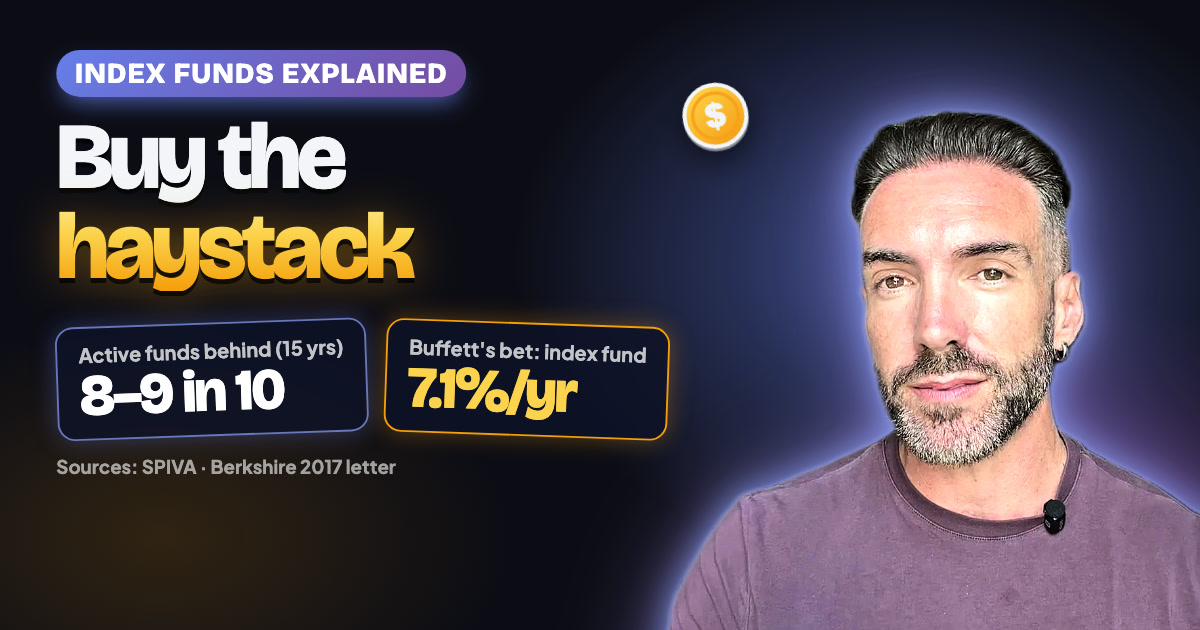
The results are boringly similar everywhere. Over fifteen years, roughly eight or nine out of every ten actively managed funds end up behind their index. Full-time professionals, and most of them lose to a list.
It's not because fund managers are stupid. Most of them are very smart. There are two reasons.
Reason 1: the maths. All the investors in the market, added together, are the market. So before costs, the average investor gets the average return. But professionals charge for their work: research, trading, salaries, marketing. Some charge 1% a year or more. An index fund can charge a tenth of that, or even less. So after costs, the average professional has to fall behind the average.
Reason 2: winners don't stay winners. A fund that tops the charts one year very often slides back to the middle, or worse, the next. It's really hard to pick next year's best fund by looking at last year's.
Warren Buffett's million-dollar bet
In 2007, Warren Buffett made a bet: a million dollars, going to charity. He bet that a plain, low-cost index fund following the S&P 500 would beat a group of hedge funds, chosen by professionals, over ten years. Hedge funds are about as fancy and as expensive as investing gets.
A firm took the bet and picked five funds of hedge funds to compete. The clock started in 2008, right before one of the worst crashes in decades.
| 2008–2017 | Average a year |
|---|---|
| Index fund (S&P 500) | about 7.1% |
| Five funds of hedge funds | about 2.2% |
Source: Berkshire Hathaway 2017 shareholder letter.
Buffett won by a mile, and the money went to a charity for girls in his home town. And here's the part I love: Buffett has said that when he's gone, most of the money he leaves for his wife should go into a very low-cost index fund (Berkshire Hathaway 2013 letter). One of the best stock pickers in history, recommending you don't try to pick stocks.
What fees do over 30 years
Why does a small difference in fees matter so much? I wrote a whole article on this: the 1% fee that eats almost a third of your money. Here's the short version.
Say two people each invest $100,000 for thirty years, and the market grows 7% a year (illustrative, before tax and inflation).
| Yearly fee | After 30 years |
|---|---|
| 0.1% | about $740,000 |
| 1% | about $574,000 |
That's more than $160,000 gone, just on fees. And that assumes the expensive fund keeps up with the market, which, as we've just seen, most of them don't.
It's compounding working against you. In why starting early beats investing three times as much, we talked about the snowball rolling down the hill. Fees are a hole in the snowball. Low fees mean almost all of the snow stays on.
What an index fund won't do for you
So should everyone just buy an index fund and walk away? Here's what an index fund won't do:
- It won't protect you from a crash. If the market falls 30%, your index fund falls with it. You get the whole market, the good years and the bad.
- It isn't always as spread out as it sounds. In some indices, a handful of giant companies make up a big slice of the whole thing, so look at what's actually inside.
- It isn't always cheap. Some charge far more than they need to, so check the fee.
- It won't stop you from panicking. The fund does its job. Your job is to leave it alone. Most people who lose money with index funds lose it by selling at the bottom.
4 things to check when comparing index funds
- What does it track? A broad index, with lots of companies and countries, spreads your risk more than a narrow one.
- What's the yearly fee? Lower is better, and the difference between two funds tracking the same index is often just cost.
- How closely does it follow its index? A good fund stays very close to the index it copies.
- What does it cost to buy? Platform fees and trading costs can matter, especially if you invest small amounts often.
Tax and the kinds of accounts you can use depend on where you live, so check your country's rules or get proper advice.
To recap
- An index is a list of companies, and an index fund simply owns the whole list.
- Most professional fund managers fall behind their index over the long run, mostly because of costs.
- Warren Buffett bet a million dollars on an index fund, and won easily.
- Small differences in fees turn into huge differences over decades.
- An index fund still goes down in a crash, so the real skill is staying in.
Don't look for the needle. Buy the haystack.
Want to see what fees do to your own money? The calculators at pimpmywealth.com are free: try a fee of 1%, then a tenth of a percent, and look at the difference.
General information only, not financial advice. It doesn't take your personal situation into account.
Ready to Apply What You've Learned?
Use our powerful calculators to model your financial scenarios and make informed decisions
Try Our Calculators