The 1% Fee That Eats Almost a Third of Your Money
One percent sounds tiny. Over a lifetime of investing it can take almost a third of your money. Here are the fees you're probably paying, and five checks to stop the leak.
Here's a number that sounds tiny: one percent. Nobody gets out of bed for one percent.
But over a lifetime of investing, a one percent fee can quietly take almost a third of your money. Not a third of your gains. A third of everything.
And the worst part? You never see it leave. There's no bill, no email, no little notification saying "thanks for the money". It just leaks out, a bit at a time, every single year. So here are investment fees explained in plain English: the fees most people don't know they're paying, why one percent is a much bigger number than it sounds, and the five checks I'd do to stop the leak.
Quick note: this is general information, not advice. Fees and the rules around them are different depending on where you live, and every number in this article is an illustrative example.
The investment fees you're probably paying
Think of this as opening the bill that nobody ever sends you. There are five main types.
1. The fund fee. Every fund, whether it's an ETF, an index fund or an actively managed fund, charges a yearly fee. You'll see it called the expense ratio, the ongoing charge or the management fee. Same thing: a percentage of your money, taken every year. You don't pay it with a card. It comes straight out of the fund, so the price you see is already after the fee. That's exactly why it's so easy to ignore.
2. The platform fee. That's what the app or website charges you to hold your investments. Some are free, some charge a flat amount, and some charge a percentage of everything you hold.
3. Trading costs. A fee each time you buy or sell, plus a small gap between the buying price and the selling price, called the spread. If you only buy a few times a year, this one is small. If you trade every week, it adds up fast.
4. Advice fees. If you pay a financial adviser, that might be a one-off fee, a yearly fee or a percentage of your money. Good advice can be worth it, and I'll come back to that.
5. The sneaky ones. Performance fees, where the manager takes a slice of any gains above a target. Entry or exit fees on some older products. And currency conversion fees when you buy shares from another country.
Not all of these will apply to you. But most people are paying at least two of them, and a lot of people are paying four.
Why a 1% fee is so much bigger than it sounds
A fee isn't charged on your gains. It's charged on your whole balance, every year, whether the market went up or down.
Say, as an illustration, your investments earn 7% in a year. A 1% fee doesn't take 1% of that 7%. It takes one percentage point out of your seven. That's about a seventh of your return, gone, before you've done anything. And in a bad year, when the market falls, you still pay it. The fee never has a bad year.
Then compounding gets involved. The money that leaves as a fee isn't just gone: all the growth it would have earned for the next thirty or forty years is gone too. Compounding works for you on your returns, and it works against you on your fees.
What a 1% fee costs: the numbers
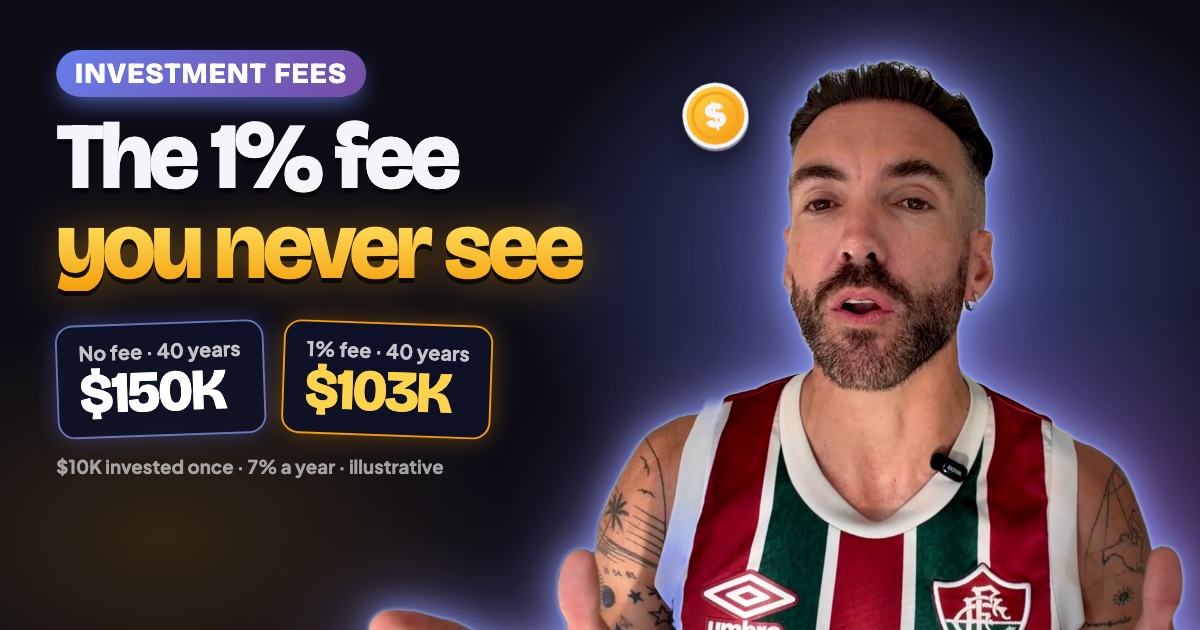
Let's put some illustrative numbers on it. Say you invest $10,000 once and leave it alone for 40 years, earning 7% a year before fees:
- No fees: it grows to about $150,000
- A low 0.2% fee: about $139,000
- A 1% fee: about $103,000
That one percent cost you around $47,000. Almost a third of what you could have had, from a fee that sounded too small to worry about.
Now something more realistic. Most people don't invest once; they add a bit every month. Say $500 a month for 30 years, at the same 7%:
- No fees: roughly $600,000
- A 1% fee: roughly $500,000, so about $100,000 just for the fee
- A 2% fee (which some older products and advice setups still charge all in): roughly $420,000, almost $200,000 less
Illustrative only: yearly compounding, with the fee taken off the return. Real returns go up and down.
Do expensive funds earn their fee?
"Surely the expensive funds are better? You get what you pay for." That's the logic everywhere else in life, but investing is a bit strange.
A cheap index fund doesn't try to be clever. It just buys the whole market, or a big slice of it, and charges very little to do it. An actively managed fund pays a team to pick the winners, and that costs more.
The research on this has been running for decades. S&P publishes a report on it (SPIVA) twice a year, and over fifteen years most actively managed funds end up behind the simple index they're trying to beat, once fees are taken off.
That's not because fund managers aren't smart. Most of them are very smart. It's because the fee is a head start everyone else gets. The manager has to beat the market by more than their fee, every year, just to break even with the cheap fund. Some do it for a while. Very few do it for decades, and it's very hard to know in advance which ones will.
When a fee is worth paying
So are all fees bad? No, and this is the bit a lot of fee articles skip. You're paying for something. The question is whether you get more than you pay.
A good adviser who stops you selling everything in a panic, sorts out your tax or helps you plan your whole life can be worth far more than their fee. Some closed-end funds charge more but give you something different, like smoother income. That's a choice, not a mistake, as long as you know what you're paying.
What you don't want is paying for nothing: a high fee for a fund that basically copies the index, or a percentage fee for advice you never actually get. That's the leak worth fixing.
5 checks to stop the leak
Nothing fancy. You could do all of these this weekend.
- Find the fund fee. Look up each fund you own and find the yearly fee (expense ratio or ongoing charge) on the fund's own page or fact sheet. Many broad index funds charge well under half a percent; some charge well under a tenth of a percent.
- Check your platform. What does the app or website charge just to hold your money? If it's a percentage, it grows as your money grows.
- Add it all up. Fund fee, plus platform fee, plus advice fee if you have one. That total is your real number, and it's often bigger than people think.
- Look for the sneaky extras. Performance fees, exit fees, currency conversion. Read the bit of the document nobody reads; it's usually only one page.
- Ask what you're getting for it. If a fee buys you something you value, fine. If you can't explain what it's buying you, that's the one to look at first.
One warning: before you move money to a cheaper option, check what it costs to move. Selling can mean tax, and some products charge exit fees. Sometimes moving is worth it and sometimes it isn't, and the rules differ depending on where you live, so check yours first.
Recap
- Fees are charged on your whole balance, every year, in good years and bad.
- 1% can take about a seventh of your yearly return, and over decades almost a third of your money.
- Expensive funds mostly don't beat cheap ones once fees are taken off.
- Some fees are worth paying, as long as you know what they buy you.
- The five checks: find the fund fee, check your platform, add it all up, look for the sneaky extras, and ask what you're getting.
Have you ever added up what you're actually paying? Were you surprised?
Want to see what a fee does to your own numbers? Try the free calculators at PimpMyWealth, with and without the fee →
This article is general information only, not financial advice. It doesn't take your personal situation into account. Fees and the rules around them differ depending on where you live, and the numbers are illustrative examples, not promises. Do your own research or speak to a licensed adviser before making investment decisions.
Ready to Apply What You've Learned?
Use our powerful calculators to model your financial scenarios and make informed decisions
Try Our Calculators