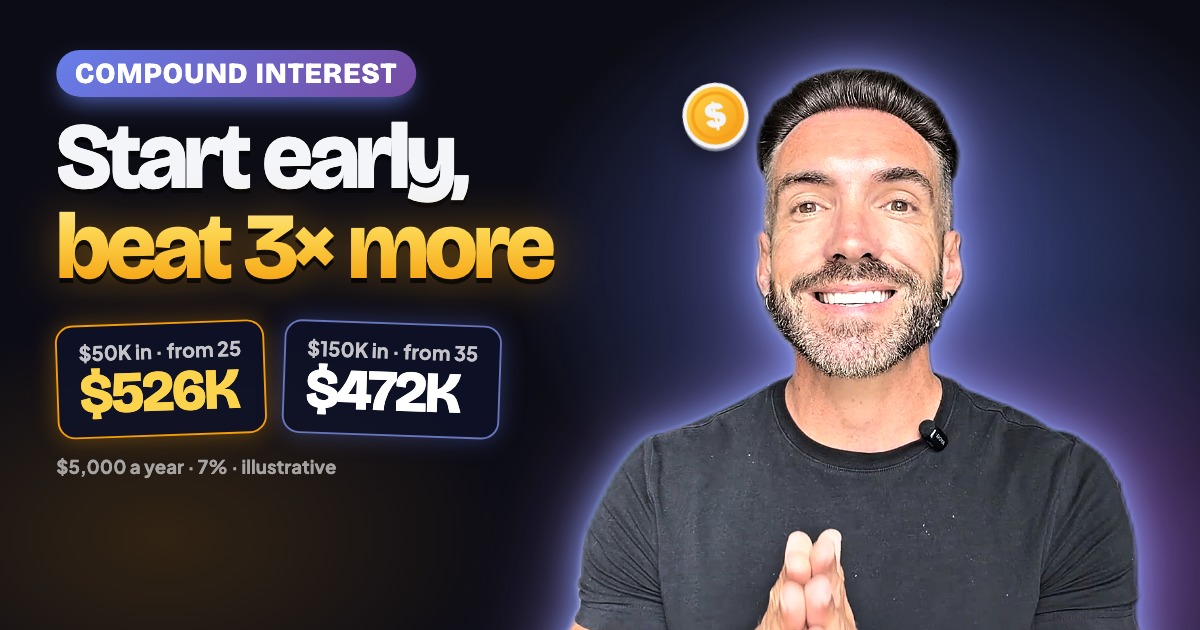
Why Starting Early Beats Investing Three Times as Much
Compound interest explained in plain English: why ten early years can beat thirty later ones, what waiting really costs, and what to do if you started late.
Two people invest the same amount every year. One starts at 25, invests for ten years, and then stops completely. The other starts at 35 and keeps going for thirty years, all the way to 65.
So the second person puts in three times as much money. And at 65, the first person still ends up with more.
That's not a trick. That's compounding, and it's the whole reason to start investing early. Here's compound interest explained in plain English: what it really is, why the first ten years feel so boring, what waiting actually costs you, and what to do if you feel like you've started late.
Quick note: this is general information, not advice. Every number in this article is illustrative (7% a year, compounding once a year, before fees, tax and inflation), and real returns go up and down from year to year.
Compound interest explained: a return on your return
Compounding is earning a return on your return.
Say you invest $100 and it grows by 7%. Now you have $107. Next year, you don't earn 7% on the $100. You earn it on the $107. The growth from last year starts growing too.
In year one, that extra bit is tiny. But it never stops, and it gets bigger every single year.
Think of a snowball rolling down a hill. At the top, it's the size of your fist. Every turn picks up more snow, and the bigger it gets, the more snow it picks up on each turn. By the bottom of the hill, it's the size of a car.
Compare that with simple interest, where you only ever earn on the money you first put in:
- $10,000 at 7% simple interest for 40 years becomes $38,000.
- The same $10,000, compounding at 7%, becomes about $150,000.
Same money. Same rate. Almost four times as much, just because the growth was left to grow.
Why the first ten years feel so boring
Here's the part nobody tells you: compounding is boring at the start. Follow that same $10,000:
- After 10 years: about $19,700
- After 20 years: about $38,700
- After 30 years: about $76,100
- After 40 years: about $149,700
Look at that shape. In the first ten years you made about $10,000 of growth. In the last ten years you made more than $70,000. Same money, same rate, just more time.
The rule of 72
There's a handy shortcut. Divide 72 by your yearly return, and that's roughly how many years it takes your money to double. At 7%, that's about ten years.
So from 25 to 65, your money can double about four times (×16). Start at 35 and it's about three times (×8). That one missing doubling is the most expensive one, because it's the biggest.
You might have heard that Einstein called compound interest "the eighth wonder of the world". There's no real evidence he ever said it. But whoever did say it had a point.
Two investors, one big surprise
Back to our two investors, both earning the same illustrative 7% a year:
- Investor A puts in $5,000 a year from 25 to 35. Ten years, $50,000 in total, and then never adds another cent.
- Investor B waits until 35, then puts in $5,000 a year for thirty years, until 65. That's $150,000 in total.
At 65, Investor B has about $472,000. Which is great. But Investor A, who stopped at 35, has about $526,000.
A third of the money, and still more at the end. Why? Because Investor A's money had thirty extra years to compound. Those early dollars did the heavy lifting:
- Each $5,000 invested at 25 turned into about $75,000 by 65.
- Each $5,000 invested at 55 turned into about $10,000.
Same $5,000. A very different job.
Now, I'm not saying stop at 35. The real winner is the person who starts at 25 and keeps going. The point is that early money is the most powerful money you'll ever invest.
What waiting really costs
Let's make it more everyday. Say you can invest $300 a month. That's about $10 a day. At the same illustrative 7%, here's what you'd have at 65:
- Start at 25: about $719,000
- Start at 35: about $340,000
- Start at 45: about $148,000
Waiting ten years didn't cost you ten years of savings. It cost you more than half of the final pot.
And to catch up, the person starting at 35 would need to put in about $634 a month, more than double. Start at 45 and it's about $1,461 a month.
That's the real cost of waiting. It's not the money you didn't invest. It's the years that money would have spent growing.
The three things compounding needs
- Time. The earlier the better, but the next best time is always now.
- A decent rate, after costs. This is where fees come in. A fee doesn't just take money once: it takes growth away from your snowball every single year. The same compounding that grows your money also grows the cost of a high fee. (More on that in the 1% fee that eats almost a third of your money.)
- Leave it alone. This is the hard one. Markets fall, sometimes a lot, and when your balance drops everything in you wants to sell and wait until things feel safe again. But compounding only works if the money stays in. Sell in a panic and you often miss the recovery, and some of the best days in the market tend to come soon after the worst ones.
The investors who do best over decades are often not the cleverest ones. They're the ones who keep going, and don't interrupt it.
Started late? You haven't missed it
If you're 40 or 50 and reading this feeling a bit sick, stop right there. Here's why:
- 65 isn't the finish line. Most people don't spend all their money on the day they retire. A lot of it stays invested for another 20 or 30 years, and it keeps compounding the whole time. Someone starting at 45 can still have 30 or 40 years ahead of their money.
- Later in life, you usually earn more, so you can often put more in.
- You still control the two things that matter: keep your costs low, and leave it alone.
One easy way to do that is to automate it. Set up a regular amount that goes in every month without you thinking about it. Then you can't talk yourself out of it, and you can't forget.
And if you're younger, this is your unfair advantage. Even a small amount started now can beat a much bigger amount started later.
How much and where to invest depends on your situation and where you live, so check your options or get proper advice.
To recap
- Compounding means earning a return on your return.
- It's slow and boring at first, and then it takes off.
- At 7%, money roughly doubles every ten years, so the last doubling is the biggest.
- Starting ten years earlier can beat putting in three times as much.
- Compounding needs time, a decent rate after costs, and you leaving it alone.
- If you started late, you still have time. So start now.
Want to see what your own money could become? The calculators on PimpMyWealth are free: try starting now, then try starting ten years later, and look at the difference.
General information only, not financial advice. It doesn't take your personal situation into account.
Ready to Apply What You've Learned?
Use our powerful calculators to model your financial scenarios and make informed decisions
Try Our Calculators