Is the AI Bubble Bursting? What a Market Drop Really Means for You
The stock market just had its worst day in a year and a half, led by AI stocks. What actually happened, what a bubble really is, what history says, and five things you can do that don't involve guessing.
On 5 November 2026, the American stock market had its worst day in a year and a half. The S&P 500 fell 4.4% in a single day. The tech-heavy Nasdaq fell 5.5%. Trillions of dollars, gone in one afternoon.
And the companies that fell hardest were the ones riding the AI boom.
So everyone is asking the same question: is the AI bubble bursting?
Here's what actually happened, what a bubble really is, what history says about bubbles like this one, and what any of it means for your money. No panic, no predictions, just plain English.
Quick note: this is general information, not advice. Every example number is illustrative unless I say where it comes from, and investing always comes with risk.
What happened?
For the last few years, investors have poured money into anything to do with artificial intelligence: the chip makers, the cloud companies, the giant data centres that run AI. Their share prices went up, and up, and up.
Then the mood changed.
- After the US midterm elections, investors started to worry that politicians might slow down the building of new data centres.
- Borrowing money had become more expensive, because inflation was rising again.
- And building data centres takes a lot of borrowed money.
So investors started asking a scary question: what if all this spending doesn't pay off as fast as everyone hoped? That's when the selling started. Nvidia, the biggest AI chip maker, was the heaviest weight dragging the market down.
By that day, the Nasdaq had fallen more than 10% from its record high in October. That has a name:
- A correction is a fall of 10% or more from the top.
- A bear market is a fall of 20% or more.
So it was a scary day, but it wasn't the end of the world. At least, not yet.
What is a bubble, really?
A bubble is when prices go up because people expect prices to keep going up. Not because the business is earning more. Just because everyone else is buying.
Think of a party. At first, a few people arrive because the music is good. Then more people arrive because there's a crowd. Then people arrive just because they don't want to miss out. Eventually the room is full, the music hasn't changed, and somebody heads for the door. Then everybody heads for the door.
There are a few warning signs people look for:
- Everyone is talking about it, even people who never talk about investing.
- Prices rise much faster than profits.
- People borrow money to buy more.
- And the most dangerous sentence in investing: "this time is different."
Bubbles are not new
You've probably heard of tulip mania in Holland in the 1600s, when people supposedly paid the price of a house for one flower bulb. Historians now say the story was exaggerated, but it's still the most famous bubble of all.
A better example is railway mania in Britain in the 1840s. Railways were a real, world-changing invention, and everyone wanted a piece of them. Hundreds of new railway companies were set up, and lots of them failed. Many investors lost a fortune. But the railways still got built, and they changed the world anyway.
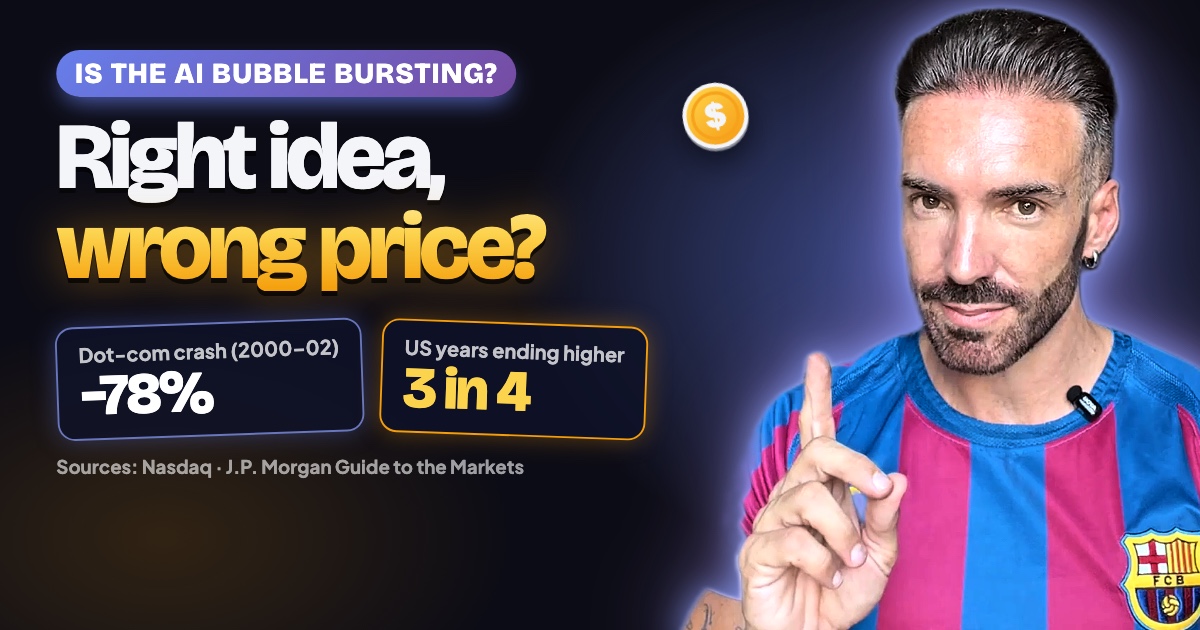
Then there's the one most people remember: the dot-com bubble. In the late 1990s, any company with ".com" in its name seemed to shoot up. In March 2000 the Nasdaq hit a record high. Over the next two and a half years it fell about 78%, and it took fifteen years to get back to that record (it finally did in April 2015).
But here's the twist. The internet was not a fad. It changed everything. Amazon survived the crash, even though its share price fell more than 90%.
So a bubble doesn't mean the idea is wrong. It often means the idea is right, but the price got ahead of reality.
So is AI a bubble?
The honest answer: nobody knows, and anyone who tells you for certain is guessing. Here are both sides.
- On one side, the biggest AI companies today make huge, real profits. That's very different from the dot-com days, when lots of companies had no profits at all.
- On the other side, companies are spending enormous amounts on data centres, and nobody knows yet how much money that spending will make. Prices can still run ahead of profits, even for great companies.
So it might be a bubble. It might be a normal correction in a long boom. It might be a bit of both. I'm not going to predict it, and I'd be very careful with anyone who does.
The better question isn't "is AI a bubble?" It's "what does this mean for my money?"
Drops like this are normal
According to J.P. Morgan Asset Management's Guide to the Markets, since 1980 the US market has dropped about 14% at some point during the year, on average. And yet about three years out of every four still ended higher.
Drops are not a sign that something is broken. They're the price of the ticket. The reason shares tend to grow more than a savings account over the long run is that you have to sit through days like this one.
You probably already own AI
Here's the part a lot of people miss. Even if you've never bought an AI stock, you probably own some.
- In an S&P 500 index fund, the ten biggest companies make up around 40% of the fund (about 40.7% at the end of 2025, according to Pensions & Investments), and most of them are big tech and AI companies.
- In a world index fund, around seven in every ten dollars is in American companies (MSCI World), so it's the same story.
That's not a reason to panic. It's a reason to know what you own.
5 things you can do (none of them are guessing)
- Have an emergency fund. A few months of living costs, in cash, that you don't invest. It means a bad day in the market never forces you to sell.
- Don't sell in a panic. When the market drops, the natural feeling is to get out. But many of the best days in the market come within a couple of weeks of the worst ones. Sell after the drop, and you can easily miss the bounce.
- Look at what you actually own. If most of your money is in a handful of tech companies or one hot theme, a drop like this hits you much harder. Spreading your money across lots of companies, countries and types of investment means no single story can sink you.
- Be careful of hype products. When a theme gets popular, new funds pop up to sell it to you, often with high fees. They tend to arrive near the top, not the bottom.
- Keep going. If you invest a bit every month, a falling market means your money buys more shares for the same price. For example, $100 buys 2 shares at $50, but 3 shares if the price falls to about $33 (illustrative). It's one of the few times investing gets cheaper.
To recap
- In November 2026, AI stocks had their worst day in a year and a half, and the Nasdaq fell into a correction.
- A bubble is when prices run ahead of reality because everyone is buying.
- History shows the idea can be right while the price is wrong, like the railways and the internet.
- Nobody knows if AI is a bubble, so don't bet everything on a guess either way.
- The things that protect you are boring: an emergency fund, a spread-out portfolio, low fees, and not selling in a panic.
Want to see what staying invested through the ups and downs can look like? The calculators at pimpmywealth.com are free.
General information only, not financial advice. It doesn't take your personal situation into account. Sources: CNN and CNBC market reports (5 November 2026); Nasdaq Composite history; J.P. Morgan Asset Management, Guide to the Markets; Pensions & Investments; MSCI.
Ready to Apply What You've Learned?
Use our powerful calculators to model your financial scenarios and make informed decisions
Try Our Calculators