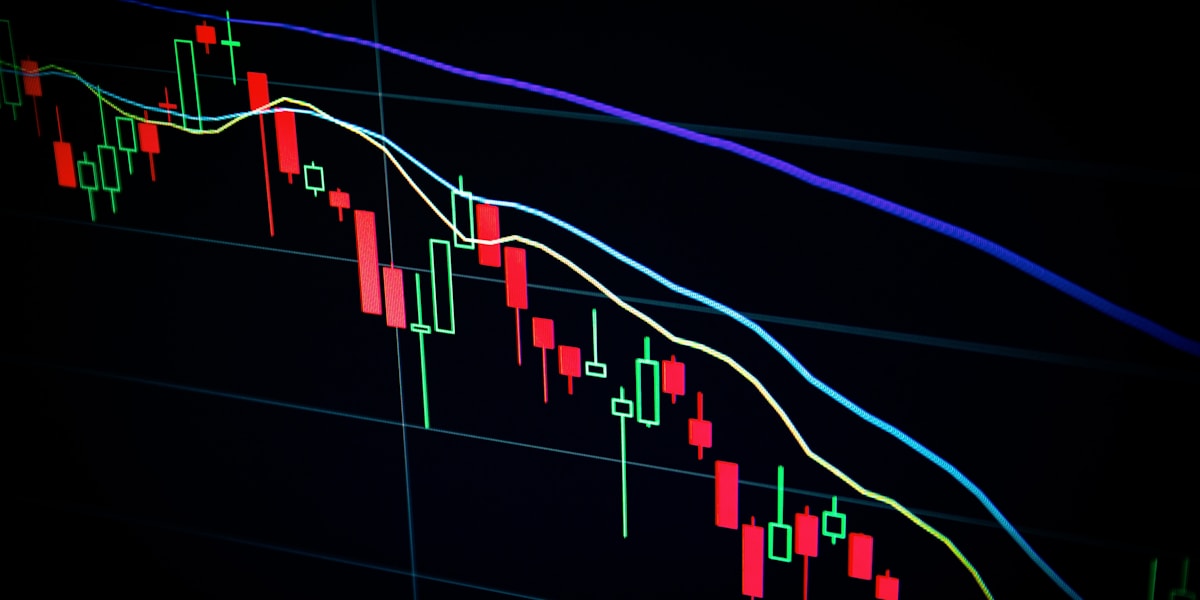
Should I Sell My Tech Stocks Right Now — or Is This Just a Dip?
Your tech stocks are deep in the red. Your AI ETF is down. And everyone online is talking about the dot-com bubble. Before you panic-sell, here's what's actually happening — and what history tells us about what to do next.
Disclaimer: This article is for informational and educational purposes only and does not constitute financial advice. Always consult a qualified financial professional before making investment decisions.
You open your brokerage app on a Tuesday morning — maybe it's before your first coffee, maybe it's during a lunch break — and the numbers are red. Not a little red. A lot red. Your Nvidia position is down double digits. Your AI ETF looks like it took a hit. And somewhere on your Twitter feed, someone is already typing the words "dot-com bubble."
So you do what every millennial investor does in 2025: you Google it.
Should I sell my tech stocks right now?
You're not alone. That exact question is being typed into search bars by millions of people every time the tech sector has a rough week. And the answer — as frustrating as it might be — is: it depends. But the why behind that answer is actually pretty fascinating, and understanding it could save you from making an expensive, emotionally-driven mistake.
Let's break it all down.
Why are AI stocks dropping right now — and is it different this time?
Before you decide whether to sell, hold, or buy more, you need to understand what's actually happening. Because not all stock drops are created equal.
The AI trade has been one of the most powerful investment narratives of the last few years. Since late 2022, when ChatGPT launched and the world suddenly understood what large language models could do, money flooded into anything with the letters "AI" attached to it. Nvidia became the most valuable company on the planet. The Magnificent Seven — Apple, Microsoft, Alphabet, Amazon, Meta, Tesla, and Nvidia — dragged the S&P 500 to record highs. ETFs tracking AI and semiconductor companies saw inflows that would have seemed absurd a decade ago.
But narratives don't last forever at full speed. And in 2025, the AI trade hit some serious turbulence.
Here's what's behind the current weakness in tech and AI stocks:
1. The DeepSeek shock changed the game
In January 2025, a Chinese AI company called DeepSeek released a model called R1 that performed comparably to the best American AI systems — at a fraction of the development cost. For investors who had been pricing in the assumption that only massive capital expenditure could produce cutting-edge AI, this was a gut punch. If you can build a world-class AI model cheaply, then maybe Nvidia doesn't need to sell quite as many $30,000 GPUs. Maybe the hyperscalers don't need to spend quite as much. Maybe the moats aren't as wide as everyone thought.
The immediate reaction was brutal. Nvidia's share price dropped 17% in a single day in January 2025 — one of the largest single-day losses in market capitalisation in stock market history. It recovered quickly, but the psychological damage lingered. Investors were no longer certain that "more spending = better AI = higher profits." The equation got murkier.
2. Capex spending is massive — and investors are nervous about the payoff
Microsoft, Meta, Amazon, and Alphabet collectively announced capital expenditure plans roughly 60% higher in 2026 than the prior year. That's an extraordinary amount of money being ploughed into data centres, chips, and AI infrastructure. A Bank of America survey found that 45% of investors viewed AI as the top market risk — not because they don't believe in AI, but because they're not sure when, or if, that spending translates into actual profits.
This is a classic "build it and they will come" bet. Sometimes it pays off spectacularly (the internet, mobile, cloud computing). Sometimes it doesn't, or at least not for the companies making the initial bets (remember how many dot-com companies built fibre optic networks only to go bankrupt?).
3. Software stocks are getting hammered by disruption fears
Here's the twist that catches a lot of investors off guard: the companies being hurt the most right now aren't necessarily the AI builders — they're the companies that AI might disrupt. HubSpot fell 39% in early 2026. Figma dropped 40%. Atlassian shed 35%. Shopify is down nearly 30%.
Why? Because the market is asking a simple, brutal question: if AI can now build software, write code, manage CRM workflows, and create marketing copy in minutes — what happens to the companies that charged businesses monthly subscriptions to do those exact things?
The honest answer is: we don't fully know yet. And markets hate uncertainty.
4. Valuations got stretched — and gravity is real
At the peak of AI optimism, a lot of tech stocks were priced for perfection. The S&P North American Technology Software Index, for instance, saw its enterprise value to forward sales ratio reach levels that left very little room for disappointment. When you're priced for a perfect future and the future turns out to be complicated, the math works against you fast.
As of early 2026, that same index is down over 20% year-to-date and sits more than 30% below its September 2024 record highs. That's not a dip — that's a significant correction.
Is it safe to hold AI stocks during a tech selloff? What history actually shows
Here's where perspective matters enormously — and where most financial media lets you down by either catastrophising or dismissing.
Let's look at the historical playbook.
Every major technology wave in modern history has followed a similar pattern: explosive adoption → speculative excess → painful correction → real-world integration → new winners emerge. The dot-com bubble is the obvious comparison everyone makes, but it's worth being precise about what actually happened.
During the dot-com crash of 2000–2002, the Nasdaq fell roughly 78% from peak to trough. Thousands of companies went bankrupt. But here's the thing: the internet was still real. Amazon survived and became one of the most valuable companies in history. Google launched during the crash and grew into a $2 trillion business. The technology was real — the valuations were just completely untethered from reality.
The question for AI in 2025 is: which scenario are we in?
The evidence suggests we're not in a dot-com style collapse. AI is genuinely useful and being adopted at speed. Revenue growth for major AI-adjacent companies, while slowing, is still substantial — software firms are still expected to grow earnings by around 25% this year, even after downward revisions. Operating margins across the sector are forecast to expand. This isn't a house of cards; it's more like a tall building that got built faster than the plumbing could keep up.
What history also shows is that investors who sold at the bottom of tech corrections — the December 2018 Fed-induced selloff, the March 2020 COVID crash, even the 2022 rate-hike bear market — almost universally regretted it. The ones who held quality companies or added during the panic consistently came out ahead over a 3–5 year window.
That doesn't mean every AI stock survives. Some won't. The market is clearly differentiating — companies with strong moats, diversified revenue, and proven profitability are holding up better than highly leveraged, single-narrative bets on AI infrastructure buildout.
Should you wait to buy AI stocks after the dip, or dollar-cost average in now?
This is the question that actually matters if you're a millennial investor with money to deploy and a long time horizon.
Let's get one thing straight: nobody — not Jim Cramer, not your mate who works in finance, not the algorithm running a $50 billion hedge fund — knows exactly when AI stocks will stop falling or where the precise bottom is. Anyone who tells you otherwise is selling something.
What we can do is think about this rationally using a few frameworks.
Framework 1: What's your time horizon?
If you're 28–40 years old and investing for retirement, you probably have a 25–40 year time horizon. In that context, whether you buy Nvidia or Microsoft or an AI ETF today versus six months from now is likely to matter very little compared to whether you invest at all. Time in the market, not timing the market, remains the most reliable wealth-building principle for long-term investors.
The risk of sitting in cash waiting for the "perfect" entry point is that you miss the recovery entirely. Markets tend to move fast when sentiment shifts — the best days in the stock market often come right after the worst.
Our Time in the Market vs Timing the Market tool shows exactly how much missing just a few of the best market days can cost you over time.
Framework 2: Are you investing or speculating?
There's a meaningful difference between buying a diversified AI ETF — something like QQQ (which tracks the Nasdaq-100) or a more specific AI-focused fund — and putting a significant chunk of your savings into a single high-volatility name like Palantir or CoreWeave.
The former is investing: you're getting broad exposure to a secular trend, and individual company failures get averaged out. The latter is speculation: you're making a concentrated bet on a specific company's ability to execute, which introduces a completely different risk profile.
For most millennial investors building wealth for the long term, the ETF route makes far more sense. You get the upside of the AI theme without the existential risk of any single company blowing up. Check out our ETF guide for more on how to evaluate different fund options.
Framework 3: Dollar-cost averaging reduces the psychological burden
Rather than trying to time the market (a strategy that fails even professional fund managers the majority of the time), consider spreading your investment over a fixed period — say, investing a set amount every two weeks or every month regardless of what the market is doing.
This approach, called dollar-cost averaging (DCA), does a few useful things. It means you automatically buy more shares when prices are low and fewer when they're high. It removes the emotional paralysis of trying to pick a perfect moment. And it turns market volatility from an enemy into something that actually works in your favour over time.
Use our Compound Interest Calculator to see how consistent investing could grow your wealth over time.
When will AI stocks stop falling? Three signals worth watching right now
Timing markets is a fool's errand, but there are legitimate indicators that historically signal when a tech sector correction is finding a floor. Here are three worth paying attention to.
Signal 1: Earnings guidance starts holding up
The most reliable sign that a sector selloff is bottoming out is when companies stop cutting their forward guidance. Right now, a lot of the weakness in AI-adjacent stocks is driven by guidance anxiety — investors fearing that the next earnings call will bring another round of downward revisions. When companies in the sector start reporting earnings that meet or beat expectations and maintain or raise their forward outlook, that's usually when institutional money starts returning.
Watch the earnings calls for Microsoft, Alphabet, Meta, and Nvidia specifically. These are the bellwethers. When they stop sounding cautious, the rest of the sector tends to follow.
Signal 2: The RSI on the tech index moves out of oversold territory
The Relative Strength Index (RSI) is a momentum indicator that measures the velocity of price moves. An RSI below 30 on a major index typically signals that selling has become excessive relative to buying — a condition known as "oversold." The S&P North American Technology Index's RSI hit its lowest recorded level in early 2026. Historically, extreme oversold readings in major sector indices are followed by meaningful recoveries — not always immediately, but within months.
You don't need to become a technical analyst to use this. Just know that when financial media starts reporting that tech stocks are at "historically oversold levels," that's usually closer to a buying opportunity than a selling one.
Signal 3: Sector rotation starts slowing
One of the clearest signals of the current market dynamic is that money has been rotating out of AI and tech and into more defensive or cyclical sectors — materials, financials, industrials, consumer staples. This rotation happens because institutional investors are repositioning, not because they've permanently abandoned tech. When that rotation starts to slow — when materials and financials stop dramatically outperforming tech — it often signals that the re-positioning is mostly complete and tech money starts to return.
Keep an eye on comparative sector performance. When the gap between tech and defensive sectors starts narrowing, the floor is probably close.
AI stocks vs index funds: which makes more sense right now for beginners?
Let's bring this back to practical territory, because this is the question that matters most for someone who's not a professional trader and just wants to build wealth sensibly.
The honest answer is: for most beginners, a broad index fund with significant tech exposure is a better starting point than picking individual AI stocks or even a narrow AI-themed ETF.
Here's why.
A fund like the Vanguard S&P 500 ETF (VOO) or the iShares Core MSCI World ETF already gives you substantial exposure to the AI theme — because Nvidia, Microsoft, Alphabet, Meta, Apple, and Amazon collectively make up a massive percentage of those indices. You get the upside of AI without betting your portfolio on any single company's execution.
If you want more targeted AI exposure, a Nasdaq-100 ETF like QQQ increases your tech and AI weighting meaningfully while still maintaining diversification across dozens of companies. This is the middle ground many millennial investors are comfortable with.
Narrow, single-theme AI ETFs — funds that hold only AI-specific companies — tend to be higher volatility, higher fee, and more susceptible to the exact kind of narrative-driven selloffs we're seeing right now. They can outperform spectacularly in bull markets and get hit harder in corrections. Only consider these if you have a specific conviction about the AI theme and you're comfortable with the added volatility.
Individual AI stocks — Nvidia, Microsoft, Palantir, AMD, Anthropic (when it eventually IPOs), etc. — are fine to include in a portfolio in moderation, as a satellite position around a core of diversified index funds. The classic framework is something like 80–90% in diversified index funds and 10–20% in individual stocks or themed ETFs you have genuine conviction about. This keeps your downside protected while still allowing you to participate in the upside of specific bets.
Understanding the difference between market-cap weighted and equal-weight ETFs can also help you choose the right fund structure for your goals.
So: should you sell?
Let's bring it home with some actual structure, because you came here for a real answer.
Sell if:
- You invested money you actually need within the next 12–24 months (emergency fund, house deposit, etc.) and the volatility is genuinely affecting your financial security
- You're highly concentrated in a single AI stock that has fundamental problems — not just narrative problems, but actual business model problems (companies losing customers, revenue declining, no path to profitability)
- Your mental health is suffering to the point where you're losing sleep and making irrational decisions — sometimes reducing exposure to sleep at night is worth more than theoretical returns
Hold if:
- You're invested in diversified funds or quality, profitable tech companies with strong balance sheets
- Your time horizon is 5 years or longer
- You bought with money you don't need in the short term
- The underlying companies you own haven't fundamentally changed — they've just gotten cheaper
Consider adding if:
- You have cash available that you genuinely won't need for 3–5 years
- You've been wanting exposure to quality AI-related companies but hesitated when valuations were high
- You're willing to dollar-cost average in over 3–6 months rather than going all-in immediately
- You understand that there may be more downside before the recovery
The emotionally hardest thing to do in a market selloff is exactly the thing that historically makes the most money: hold quality, add selectively, and don't let the noise in your phone tell you what to do with your future.
Not sure if your portfolio matches your actual risk tolerance? Use our Portfolio Builder to find out.
The bottom line
The AI trade isn't dead. But it is maturing — and that transition from pure hype to real-world integration is messy, volatile, and unsettling if you're watching your portfolio every day.
The companies that built genuinely useful products, with real revenue, strong moats, and sensible balance sheets, will almost certainly be worth more in five years than they are today. The companies that were riding pure narrative momentum with no underlying business to support their valuations? Those are the ones to be cautious about.
Most millennial investors are better served by zooming out, staying diversified, and continuing to invest consistently — rather than making reactive sell decisions based on a bad week or a scary headline.
Your 50-year-old self, watching that portfolio compound quietly for decades, will thank you for not panic-selling in 2025.
Use our Compound Interest Calculator to see how staying invested over the long term can transform your wealth.
This article is for informational and educational purposes only. It does not constitute personalised financial advice. Past market performance is not a reliable indicator of future results. Please consult a qualified financial adviser before making investment decisions.
Ready to Apply What You've Learned?
Use our powerful calculators to model your financial scenarios and make informed decisions
Try Our Calculators